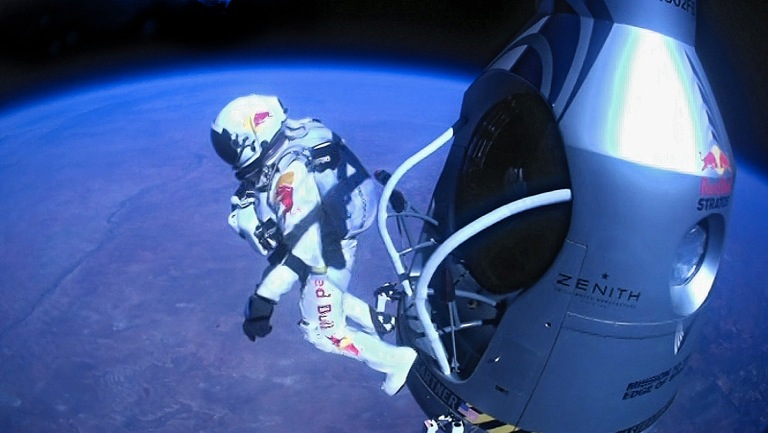
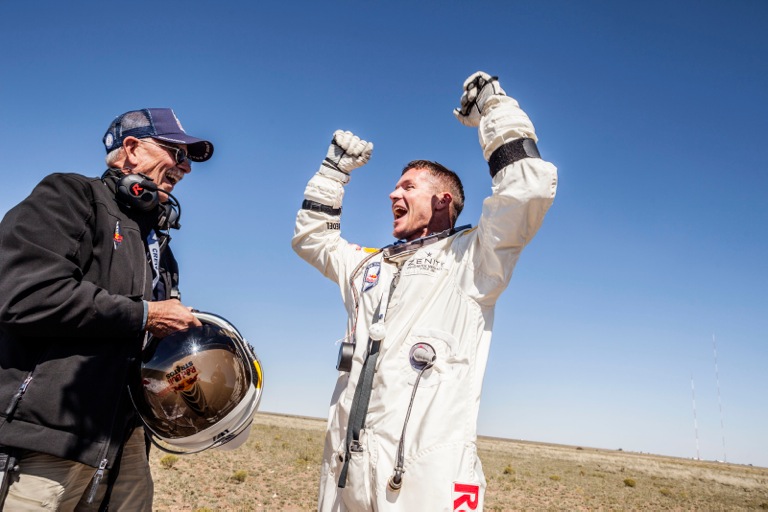
Austria's Felix Baumgartner earned his place in the history books on Sunday after overcoming concerns with the power for his visor heater that impaired his vision and nearly jeopardized the mission. Baumgartner reached an estimated speed of 1,137 kmjumping from the stratosphere, which when certified will make him the first man to break the speed of sound in freefall and set several other records* while delivering valuable data for future space exploration.
ROSWELL, New Mexico - After flying to an altitude of 39,044 meters (128,097 feet) in a helium-filled balloon, Felix Baumgartner completed Sunday morning a record breaking jump for the ages from the edge of space, exactly 65 years after Chuck Yeager first broke the sound barrier flying in an experimental rocket-powered airplane. The 43-year-old Austrian skydiving expert also broke two other world records (highest freefall, highest manned balloon flight), leaving the one for the longest freefall to project mentor Col. Joe Kittinger.
Baumgartner landed safely with his parachute in the desert of New Mexico after jumping out of his space capsule at 39,044 meters and plunging back towards earth, hitting a maximum of speed of 1,137 km/h through the near vacuum of the stratosphere before being slowed by the atmosphere later during his 4:19-minute long freefall. Baumgartner's jump lasted a total of 9:03 minutes. Countless millions of people around the world watched his ascent and jump live on television broadcasts and live stream on the Internet. At one point during his freefall Baumgartner appeared to spin rapidly, but he quickly re-gained control and moments later opened his parachute as members of the ground crew cheered and viewers around the world heaved a sigh of relief.
"It was an incredible up and down today, just like it's been with the whole project," a relieved Baumgartner said. "First we got off with a beautiful launch and then we had a bit of drama with a power supply issue to my visor. The exit was perfect but then I started spinning slowly. I thought I'd just spin a few times and that would be that, but then I started to speed up. It was really brutal at times. I thought for a few seconds that I'd lose consciousness. I didn't feel a sonic boom because I was so busy just trying to stabilize myself. We'll have to wait and see if we really broke the sound barrier. It was really a lot harder than I thought it was going to be."
Baumgartner and his team spent five years training and preparing for the mission that is designed to improve our scientific understanding of how the body copes with the extreme conditions at the edge of space.
Baumgartner had endured several weather-related delays before finally lifting off under bright blue skies and calm winds on Sunday morning. The Red Bull Stratos crew watching from Mission Control broke out into spontaneous applause when the balloon lifted off.
* The data on the records set by the jump are preliminary pending confirmation from the authorized governing bodies.
Pictures: Joerg Mitter, Predrag Vuckovic, Balazs Gardi, Stefan Aufschnaiter
BREAKING NEWS! Baumgartner's Red Bull Stratos balloon lifted off 9:31 a.m. (about 11:30pm Singapore time) in Roswell, New Mexico. The Austrian will jump from about 36,600 meters in about 2:15 hours
The Stratosphere is the second layer of the earth atmosphere and It is an inhospitable environment for any living creature. Without a space suit, a person’s body is exposed to a vacuum environment and he will be dead in 14 secs.
Tomorrow He Will Jump!
Broadcast Live on YouTube channelat 8pm Singapore time on
The Stratosphere is the second major layer of Earth's atmosphere, just above the troposphere, and below the mesosphere. It is stratified in temperature, with warmer layers higher up and cooler layers farther down. This is in contrast to the troposphere near the Earth's surface, which is cooler higher up and warmer farther down. The border of the troposphere and stratosphere, the tropopause, is marked by where this inversion begins, which in terms of atmospheric thermodynamics is the equilibrium level. The stratosphere is situated between about 10 km (6 mi) and 50 km (30 mi) altitude above the surface at moderate latitudes, while at the poles it starts at about 8 km (5 mi) altitude.
It is an inhospitable environment for any living creature. Without a space suit, a person’s body is exposed to a vacuum environment and he will be dead in 14 secs.
Normally the atmosphere cools a few degrees with a rise in altitude. Flying a jet at about 35,000 ft is typically where temperatures drop off dramatically to -50F or even -70F degrees.
The cooling trend slows down as you enter the initial layer of the stratosphere, which is never at an exact altitude. The stratosphere just like any layer of the atmosphere starts and stops at various heights depending on where you are on the planet. These layers are temperature dependent. So Bobby McGee at the equator will give a report on the altitude of the stratosphere which will differ from Jenny McGoo's report because she lives at the North Pole. These variations change with the seasons too.
So the reason the temperature actually increases as you climb through the stratosphere is due to the ozone layer. Ozone molecules absorb energy and give heat back to the stratosphere. Still, it's very cold: 0 to -10F degrees.
After attending the Media Event (by SPRG) yesterday at the iFLY Singapore, i truly understands what RED BULL STRATOS is all about.
Red Bull Stratos, a mission to the edge of space, will attempt to transcend human limits that have existed for 50 years. Supported by a team of experts Felix Baumgartner plans to ascend to 120,000 feet in a stratospheric balloon and make a freefall jump rushing toward earth at supersonic speeds before parachuting to the ground. His attempt to dare atmospheric limits holds the potential to provide valuable medical and scientific research data for future pioneers.
The Red Bull Stratos team brings together the world's leading minds in aerospace medicine, engineering, pressure suit development, capsule creation and balloon fabrication. It includes retired United States Air Force Colonel Joseph Kittinger, who holds three of the records Felix will strive to break.
Joe's record jump from 102,800 ft in 1960 was during a time when no one knew if a human could survive a jump from the edge of space.Joe was a Captain in the U.S. Air Force and had already taken a balloon to 97,000 feet in Project ManHigh and survived a drogue mishap during a jump from 76,400 feet in Excelsior I. The Excelsior III mission was his 33rd parachute jump.
Although researching extremes was part of the program's goals, setting records wasn't the mission's purpose. Joe ascended in helium balloon launched from the back of a truck. He wore a pressurized suit on the way up in an open, unpressurized gondola. Scientific data captured from Joe's jump was shared with U.S. research personnel for development of the space program. Today Felix and his specialized team hope to take what was learned from Joe's jumps more than 50 years ago and press forward to test the edge of the human envelope.
Due to the overly strong winds at ROSWELL launch site, the LAUNCH DATE would be postponed to 9th October 2012 (Tues), same time 8 PM.Live Telecast can be viewed on YouTube here http://www.youtube.com/redbull or Red Bull Stratos website www.redbullstratos.comon Tuesday, 8pm!
FELIX BAUMGARTNER arrived at the launch site in Roswell, NM when he got the news from meteorologist Don Day. The launch of the mission to the edge of space will not take place on Monday as scheduled, but most probably on Tuesday.
The reason for the delay is a strong cold front with sharply colder temperatures, low clouds and some drizzle that will be moving through eastern New Mexico over the weekend. While the weather will greatly improve on Monday with clearing skies and warmer temperatures, wind speeds are expected to be above acceptable levels for a safe launch on Monday morning. Wind speeds are forecast to be between 8 to 16 km/h/ 5 to 10 mph from the with winds above the ground at balloon top between 16 to 24 km/h/ 10 to 15 mph, Red Bull Stratos meteorologist Don Day explains. Baumgartner will launch with the largest manned balloon in history: 550 feet/ 168 meters high at the start with a volume of 30 million cubic feet/ 850.000 cubic meters!
“The good news is that we usually have a day or two after this type of cold front moves through where the weather can be favorable for a balloon launch“, Don Day says.
The delay does not influence the preparations on site. In the dress rehearsal in the night from Friday to Saturday, Felix Baumgartner and the team will go through the 7-hour pre-launch procedure exactly as it will occur on Tuesday morning.
Whet your appetite for the forthcoming cosmic expedition that is Red Bull Stratos by watching this short teaser. What looks like a trailer for a Ridley Scott film is nothing less than a new chapter of history being written. Supported by a team of experts, Austrian skydiver Felix Baumgartner will take a balloon flight to more than 120,000ft before making a record-breaking freefall in which he hopes to become the first man to break the speed of sound while delivering valuable scientific data in the process. This is a human challenge on the edge of space, an exploration into the unknown.
This is a very cool cinematic trailer.. just released few days ago!
The European Red Bull(denoted with blue and silver colour) – Red Bull Stratos – Mission to the edge of space is ready to be launch on 8th October9th October and they have lined up a series of behind-the-scenes videos as a prelude to the jump!
In this mission, Felix Baumgartner will undertake a stratospheric balloon flight to more than 120,000 ft (36.576 m) and make a record-breaking freefall jump attempting become the first man to break the speed of sound in freefall while delivering valuable data for medical and scientific advancement.
They have prepared the countdown timer towards this history-in-the making moment and it can be found on (the website of publisher)
The mission will be Broadcast Live on YouTube channel. on 8th Oct 20129th Oct 2012at 8pm Singapore time: